


Spotify pays an estimated $0.003 to $0.005 per stream on average in 2026. Based on that range, one million eligible streams could generate approximately $3,000 to $5,000 in gross royalties.
This is a useful estimate rather than a fixed rate. The amount generated depends on factors including the listener’s country and subscription type, while the amount you eventually receive will be affected by agreements with your label, distributor, publisher and collaborators. For a more personalised estimate, try our free streaming royalty calculator. You can enter your streams, choose a currency and account for your royalty share and distributor cut.
How much does Spotify pay per stream in 2026?
A reasonable planning range is $0.003 to $0.005 per eligible stream, or approximately $3 to $5 for every 1,000 streams before any deductions. Spotify does not assign the same monetary value to every play. It combines revenue from Premium subscriptions and advertising into separate royalty pools for different markets. Roughly two-thirds of its music revenue is allocated to recording and publishing royalties, which are distributed to rights holders according to streamshare. Your royalty statement is therefore the only reliable record of what your music earned. The average rate simply helps you understand the likely scale.
How much could you earn from Spotify streams?
Using the estimated range:
- 1,000 streams: approximately $3 to $5
- 10,000 streams: approximately $30 to $50
- 100,000 streams: approximately $300 to $500
- 500,000 streams: approximately $1,500 to $2,500
- 1 million streams: approximately $3,000 to $5,000
These are gross estimates rather than guaranteed payments. Spotify’s eligibility rules still apply, and the amount an artist keeps will depend on their ownership, contracts and royalty splits. Our free Spotify royalty calculator lets you adjust the listener market, currency, royalty share and distributor cut to create a more relevant estimate.
How Spotify actually pays artists
Spotify uses a system known as streamshare. Revenue from subscriptions and advertising is divided into royalty pools, and eligible recordings receive a share based on their proportion of eligible streams in each market during the relevant period. For example, if a recording represented 1% of eligible streams in a particular pool, its rights holders would receive 1% of the recording royalties available within that pool.
Spotify generally pays rights holders rather than artists directly. The money then moves through the appropriate organisations before reaching the people involved in the recording and composition.
There are two main types of royalty:
- Recording royalties relate to the sound recording and are generally paid through a record label or distributor.
- Publishing royalties relate to the underlying song and are paid through publishers, performing rights organisations and mechanical collection agencies.
The amount that reaches an artist or songwriter depends on their individual agreements with those rights holders.
Why Spotify’s per-stream payout varies
The effective value of a Spotify stream changes because the revenue and listening activity behind it are not always the same.
- Premium and free listeners
Premium subscriptions generate more revenue than Spotify’s advertising-supported service. Streams from Premium listeners will therefore usually contribute more to the relevant royalty pool. - Listener location
Subscription prices, advertising income, currencies and listening levels vary between countries. The geographical mix of your audience can consequently affect the royalties generated. - Overall streaming activity
Because payments are based on streamshare, your earnings are affected by both your own eligible streams and the total number of eligible streams in that market. - Your agreements
The royalty received by your label or distributor is not necessarily the amount that reaches your bank account. Ownership, distribution terms, publishing arrangements and collaborator splits all affect the final payment.
Editorial, algorithmic and independent-playlist streams do not have special fixed rates. Their wider value comes from the listeners they reach and whether those listeners save, follow, replay or explore more of the artist’s catalogue. These behaviours can also help Spotify understand the audience for a track. Our guide to Spotify’s algorithm trigger points explains those signals in more detail.
Does every Spotify stream earn royalties?
No. Since April 2024, a recording must generally have received at least 1,000 streams globally during the previous 12 months to enter Spotify’s recorded music royalty pool. Spotify also requires a minimum number of unique listeners. It does not publish the exact figure because the information could be used to manipulate the system.
Eligibility is reassessed monthly, so a recording can move into or out of the royalty pool as its rolling stream count changes. Once it qualifies, eligible streams from that month can enter the calculation, but earlier ineligible months are not paid retrospectively. This rule applies to recording royalties. Publishing royalties are calculated separately.
When does Spotify count a stream?
Spotify counts a song stream when somebody listens to the track for at least 30 seconds. However, a counted stream is not automatically eligible for royalties. The recording must satisfy Spotify’s monetisation requirements, and the listening activity must be considered legitimate.
Streams from downloaded music are reported when the listener next goes online. Spotify requires users to reconnect periodically so their offline listening can be counted.
What does the 1,000-stream rule have to do with an ISRC?
Spotify applies its recording royalty threshold to each unique recording. In practical terms, this normally means each ISRC must qualify separately. An ISRC, or International Standard Recording Code, identifies a specific sound recording. A studio version, acoustic recording and live version of the same song may each have different codes and separate stream totals.
If you need to check the code attached to a recording in Spotify’s catalogue, use our free ISRC finder. You can search by song and artist or paste a Spotify link, with no sign-up required.
How does Spotify compare with other streaming platforms?
Spotify’s estimated $0.003 to $0.005 rate is often lower than the figures associated with some competing services. Common planning estimates include:
- Apple Music: $0.007 to $0.010 per stream
- Amazon Music: $0.004 to $0.006 per stream
- Tidal: $0.012 to $0.015 per stream
- Deezer: $0.005 to $0.007 per stream
- YouTube Music: $0.0007 to $0.002 per stream
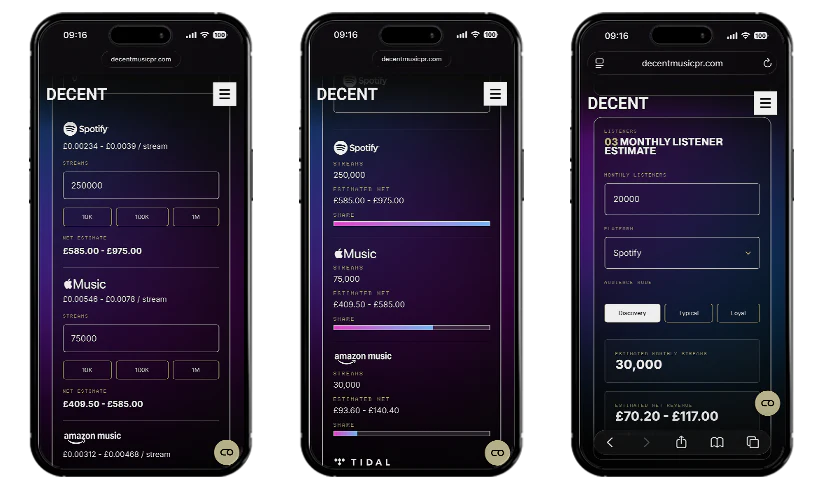
These are broad estimates, not guaranteed rates. Every platform has different subscription plans, audiences, markets and listening patterns. A higher average per stream does not automatically produce more income. A smaller service may pay more for an individual play but generate fewer streams overall, while Spotify’s scale gives artists access to a much larger potential audience. You can compare estimated earnings across the main platforms with our royalty calculator.
What Spotify royalties actually mean for artists
At a small or mid-level scale, streaming income alone is unlikely to cover everything involved in creating and releasing music. That does not make streaming unimportant. A genuine stream can lead to a save, follow, repeat listen, ticket sale or somebody exploring the rest of your catalogue. Ten thousand streams from listeners who immediately leave tell a very different story from ten thousand streams that generate sustained engagement.
Spotify for Artists data can also support practical decisions. Listener locations may inform tour planning, while saves, repeat plays and catalogue activity can help shape future releases. Sustained audience growth can also strengthen pitches to press, radio, labels and booking agents. Royalties are therefore one measure of a release’s performance, rather than the sole reason to promote it.
How to earn more from your Spotify streams
You cannot control the size of Spotify’s royalty pools, but you can improve how effectively your music reaches suitable listeners.
- Give Spotify a clear audience signal
Relevant playlists, direct fan activity and consistent positioning can help Spotify understand who is likely to enjoy your track. Our Spotify playlisting service focuses on reaching suitable listeners through real curators rather than generating empty volume. - Pitch your music before release day
Submit unreleased music through Spotify for Artists with enough time for its editorial team to consider it. Placement is never guaranteed, but a properly prepared pitch gives the release a fair opportunity. Read our guide to getting on Spotify editorial playlists before submitting your track. - Encourage meaningful listener activity
Saves, follows, repeat listening and catalogue exploration are stronger indicators of genuine interest than a one-off stream. Make sure your artist profile, artwork, release story and wider catalogue give new listeners a clear reason to stay. - Build a discovery channel you own
An artist-owned playlist can support multiple releases and continue attracting listeners after an individual campaign ends. Our Spotify playlist growth service helps artists develop playlists around a clear listener promise, relevant catalogue and long-term audience. - Avoid guaranteed-stream offers
Bought or automated streams can distort your data and put your music at risk. Spotify says artificial streams do not earn royalties, contribute to public totals or positively influence its recommendation systems. More serious cases can result in playlist removal, distributor penalties or the track being removed from Spotify altogether.
How Decent helps artists grow genuine Spotify streams
Decent Music PR runs human-led campaigns focused on real curators, suitable audiences and transparent Spotify for Artists and Chartmetric data. We do not use fake playlists or botted streams. Our aim is to help artists reach people who are genuinely suited to their music and more likely to keep listening. If you would like an honest assessment of the best route for your next release, submit your music and our team will review it.
Final thoughts
The best working estimate for Spotify’s 2026 payout is $0.003 to $0.005 per eligible stream, making one million streams worth approximately $3,000 to $5,000 gross. The exact result will depend on the listeners behind those streams and the agreements between you and your rights holders. Use the figure as a planning guide, then focus on building the kind of genuine audience that continues listening beyond one release.
Frequently asked questions
- How much does Spotify pay per stream in 2026?
Spotify pays an estimated $0.003 to $0.005 per eligible stream, although there is no fixed official rate. - How much does Spotify pay for 1 million streams?
One million eligible streams could generate approximately $3,000 to $5,000 in gross royalties before any contractual deductions. - How much does Spotify pay for 100,000 streams?
Using the estimated average range, 100,000 eligible streams could generate approximately $300 to $500 gross. - How much does Spotify pay for 1,000 streams?
One thousand eligible streams could generate approximately $3 to $5. The recording must also satisfy Spotify’s monetisation requirements. - How many Spotify streams are needed to make $1,000?
Depending on the effective rate, it could take approximately 200,000 to 333,334 eligible streams to generate $1,000 gross. - Why are Spotify’s payouts so low?
Spotify distributes roughly two-thirds of its music revenue through royalty pools. The effective rate is influenced by subscription income, advertising revenue and overall listening activity. - Does Spotify pay for every stream?
No. Recording royalty eligibility generally requires 1,000 streams in the previous 12 months and a minimum number of unique listeners. Artificial streams do not earn royalties. - How and when does Spotify pay artists?
Spotify pays labels, distributors, publishers and other rights holders. They then pay artists and songwriters according to their respective agreements and schedules.