Can anyone offer "guaranteed playlist placements"?
Not in the way most people who search for guaranteed playlist placements are hoping.
Nobody can promise your song a spot on a particular Spotify playlist, and nobody outside Spotify can promise you an editorial one, however good their contacts are. An honest company can still stand behind the work it does, which means who it pitches, how it vets those curators, how it reports back and what happens if the campaign falls short.
That difference matters more than it sounds, because a promise of named playlists, editorial selection or a set number of streams is one of the clearest playlist promotion red flags there is. This guide covers why placements can't be promised, what a fair guarantee looks like, and how to check your own Spotify for Artists data for signs of fake playlists and bot streams.
Why nobody can guarantee an editorial playlist
Spotify's editorial playlists, the likes of New Music Friday and Fresh Finds Pop, are chosen by Spotify's own editors. Spotify has said every artist uses the same pitching tool, that pitches are read, and that far more artists pitch than can ever be placed. So an agency can make sure your pitch is complete, clear and in on time, but the decision isn't theirs to make.
There are practical limits as well. Only one track per release can be pitched to editorial, and only before it comes out, so the song has to be unreleased and submitted in advance, with correct metadata and a clear story behind it.
We've landed artists on editorial playlists before (some of those results are in our artist campaign case studies), but past placements are examples, never a promise for the next campaign. The pitch itself is covered in our guide to Spotify editorial playlists.
And independent curator playlists?
Our playlisting campaigns work with independent curators, the people and brands who run their own playlists around a genre, a mood or a scene. They decide what goes on their lists, which is exactly why a placement means something. When a curator adds a track because it suits the playlist, it lands in front of listeners who chose that playlist for that sound.
An honest playlisting company can promise to pitch, follow up and keep pitching. It can't promise that any one curator will say yes.
So when a company can name the playlists your song will land on before anyone has listened to it, or tell you how many streams you'll get, it's fair to ask how it knows.
What a fair guarantee looks like
A guarantee isn't automatically a bad sign. The useful question is what exactly is being guaranteed.
| Can be guaranteed honestly | Can't be guaranteed by anyone |
|---|---|
| Pitching and follow-up to curators who suit the song | A place on a named playlist |
| Curators who are vetted and genre-matched | Selection for a Spotify editorial playlist |
| Working toward an agreed placement target, with clear terms if it's missed | A set number of streams or listeners |
| Regular reporting on where the streams come from | Pickup by Radio, Discover Weekly or Release Radar |
Decent's Spotify playlisting service is performance-backed. We pitch to vetted, genre-matched independent curators, with no fake playlists and no bots, and we work toward an agreed placement target. Before you commit to anything, we'll explain exactly what's included and what happens if that target isn't reached.
We won't promise a named playlist, an editorial placement or a stream count, because none of those are ours to give.
Red flags when a promoter guarantees placements
Comparing playlist promoters? These are the things that should make you slow down.
- Guaranteed placements on named or editorial playlists. Spotify's editors decide editorial, and curators decide their own lists.
- Guaranteed streams. A stream count depends on who listens, and nobody controls that.
- No named person behind the company. You should know who's running your campaign and how to reach them.
- Curators nobody can tell you about. When a company can't explain how its curators are found and checked, treat the whole network with suspicion.
- Pressure to pay a curator directly. That's a warning sign in its own right, and a good reason to walk away.
- Vague deliverables. You should get a straight answer on what will be done, how long it runs and how results are reported. No answer, no deal.
For the wider version of this list, covering any promotion company (us included), see the red flags section of our post Is Decent Music PR legit?
How to spot fake playlists in your Spotify for Artists data
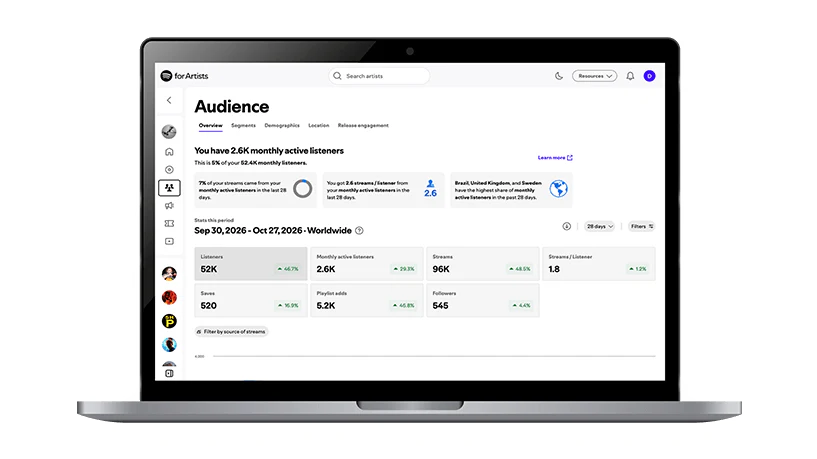
Even with a careful promoter, it's worth knowing what artificial streaming looks like in your own numbers. Spotify for Artists splits your streams by source: your artist profile and catalogue, listeners' own playlists and library, editorial playlists, personalised sources such as Radio, autoplay and mixes, other listeners' playlists, and the play queue. Reading each source against its listener count is where problems tend to show up.
Far more streams than listeners from one source
Real people don't play one song dozens of times a day. Decent's own Spotify data shows that genuine listening from any one source stays modest per listener, even among very engaged fans, so when a source shows far more streams than listeners, a handful of "listeners" are playing the track over and over. That isn't how people listen.
The awkward part is where those streams tend to land. Our research found they usually arrive through the artist profile and catalogue source, which is also where deliberate listening from real fans sits, so a big total there can look like a loyal fanbase. Check it against the listener count for that source before you celebrate.
Spikes with nothing behind them
A jump in streams with no matching rise in listeners, followers or a source that makes sense is worth looking into. So is a run of big spikes followed by steep drops, although on its own that can simply mean the exposure was short-lived.
Streams without engagement
Real placements produce some saves, some listening from people's own libraries and some adds to listeners' own playlists. Streams that keep arriving with none of that, week after week, deserve a closer look.
Geography that doesn't fit
Check whether the countries your streams come from make sense for the playlist and the genre. Be careful with this one, though, because streams from lower-cost markets aren't low quality by default, and the better test is whether those listeners save, replay and add the song to their own playlists.
No single signal proves anything, and daily ups and downs are normal. Treat these as reasons to ask questions rather than as verdicts. We check every campaign for these patterns, and it's a fair thing to ask any promoter whether they do the same.
Why a real placement beats a guaranteed number
Spotify has said that pure play count barely counts. By its account, the things that matter are saves, playlist adds, repeat listening, streams per listener and active rather than programmed streams. It's also said that listeners who skip, play once and never save can work against a song, which makes a pile of mismatched streams worse than fewer, better ones.
That lines up with Decent's own Spotify data. Across more than 1,800 tracks, our research found that saves are what convert reach into recommendations, and that algorithmic streams follow listening from people's own libraries far more closely than listening from other people's playlists. Real, relevant placements feed that, producing saves at a steady rate of roughly one for every 170 to 200 playlist streams, with smaller artists converting at a higher rate than bigger ones. Our guide to how Spotify's algorithmic playlists work goes further into those recommendation surfaces.
They keep working after a campaign ends, too, because the song stays on the lists. Across 32 campaigns, more than half of the daily uplift was still arriving a month after the campaign finished, and around a quarter was still there three months on. The research also suggests that sitting on playlists next to similar artists places an artist in those artists' Radio neighbourhoods, though that effect fades as the placements age.
Bot streams are a different story. They aren't an audience, and they put the release at risk. Platforms remove songs, and sometimes whole catalogues, over artificial streaming, and industry contacts who read the data can spot it.
Questions to ask before paying for playlist promotion
Whether you're talking to us or anyone else, ask every company the same things.
- Where will the streams come from, and how are the curators found and vetted?
- What exactly is guaranteed, and what isn't?
- What happens if the agreed target isn't reached?
- How will results be reported, and how often?
- Can I see results from past campaigns, with real data?
A legitimate company won't have a problem answering any of them. For what it's worth, our playlisting campaigns come with weekly reporting through Spotify for Artists and Chartmetric, and the case studies show what real campaigns produced.
Uneasy about the answers you get, from anyone? Don't proceed.
Growing an audience on Spotify takes consistent releases and promotion that keeps going over time, and no single placement changes that. To see how a campaign with clear terms and honest reporting works, have a look at our Spotify playlisting, or submit your music for our team to review.