


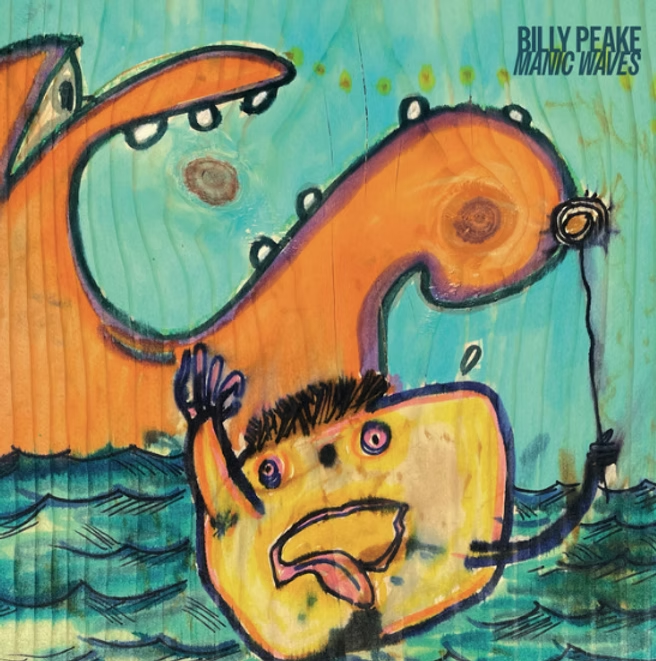
“The minor miracle isn’t that he convinced people who’ve worked with Bowie and St. Vincent to help him — it’s that the album justifies their involvement” – B-Side Guys
“Genuinely excellent… an emotional, well-crafted, and highly memorable listening experience” – Motel Void
“A brilliant piece of music that is a journey start to finish” – Hot Lunch Music
“A living, breathing album that channels the restlessness, anger, tenderness, and humour of a life lived fully in music” – Mystic Sons
Billy Peake is a Columbus, Ohio-based songwriter whose career spans decades of critically respected work before stepping away from music to focus on family and life beyond the stage. Manic Waves marks his debut solo release, written, shaped, and completed on his own terms.
Billy Peake returns with Manic Waves, a debut solo album that refuses to sit still. It’s political, but it moves. It’s sharp, but it hooks. It’s angry, but it laughs.
This is not protest folk, and it’s not background indie rock. Manic Waves takes direct aim at dopamine-addicted online outrage, evangelical hypocrisy, and generational complacency, but does it with grooves, horns, and undeniable melodies. That combination is rarer than it should be.
Across 12 tracks, Peake merges indie rock, power pop, new wave, and college rock into something both familiar and strikingly current. There’s a dark sense of humor running through it all: the same record that skewers authoritarian creep also delivers love letters to his children and a confession about accidentally getting too high on gummies.
Peake spent two decades in critically respected Columbus, Ohio bands Miranda Sound and Bicentennial Bear, earning festival stages including Lollapalooza before stepping away from music to raise a family and pay down long-neglected college loans.
In 2019, a collection of attic demos, his first time writing entirely alone, began to take shape. Pandemic isolation transformed those sketches into Manic Waves, a record that balances intimacy with ambition: fuzz-drenched guitars, shimmering ’80s synths, and a songwriter finally unconstrained by band dynamics or expectations.
The result is a record that speaks directly to a generation that watched the optimism of the ’90s give way to something far more fractured. The sonic callbacks are familiar. The emotions are not.
While Manic Waves retains a handmade, personal core, its collaborators bring undeniable weight:
- Mixed by Mike Montgomery (The Breeders, Superchunk, Protomartyr)
- Mastered by Sarah Register (David Bowie, Depeche Mode, Nada Surf)
- Drums by Stephen Bidwell (Black Pumas)
- Drums by Matt Johnson (St. Vincent, Jeff Buckley)
These contributions elevate the record without diluting its identity, giving sceptical listeners every reason to pay attention.
At its core, Manic Waves lives in contradiction.
Peake writes about a world tilting toward cruelty, while acknowledging his own life is filled with love, family, and gratitude. He doesn’t resolve that tension. He leans into it.
That gap, between anger and appreciation, despair and joy, is the album.
The sound may recall late nights with college radio and stacks of records from Afghan Whigs to Blondie, but Manic Waves isn’t about revisiting youth. It’s about what happens after.
It asks a simple question: Can the sounds we loved back then still carry the weight of everything that’s happened since? Here, the answer is yes.
Track by Track
“Go Back to Where You Came From”
Peake opens Manic Waves by deliberately wrong-footing the listener. There are no guitars—just a clunky analog drum pad loop, acoustic strings repurposed as percussion, and a warped Korg organ humming underneath. It’s disorienting, immediate, and confrontational. Lyrically, it takes direct aim at inherited privilege and those who weaponize it, with a refrain that hits hard and sticks fast. It’s a bold statement of intent: this record will challenge you, but it will also hook you.
“Manic Waves”
The title track captures the psychological churn of isolation—how drifting can start to feel safe, and re-entry into the world becomes its own kind of struggle. Rather than resist the instability, the song leans into it, riding emotional peaks and troughs with a sense of reluctant acceptance. Expansive and melodic, with rich horn textures and dynamic percussion, it widens the album’s sonic palette while anchoring its central theme.
“Granddad Was a Demon”
Dark, danceable, and sharply observed, this track skewers the addictive mechanics of online outrage. Told from the perspective of a compulsive rage-poster, it imagines a digital legacy defined by cruelty. The groove is infectious, almost celebratory, while the lyrics land with a sting. That tension—movement versus message—makes it one of the album’s most striking and unsettling moments.
“Inadvertent Trip”
What begins as a wry, “dad wave” anecdote about an accidental psychedelic experience gradually reveals something far more profound. As the song unfolds, humor gives way to reflection, regret, and ultimately a fragile kind of reconciliation. A hallucinated conversation with Peake’s late father becomes the emotional core, transforming a comedic premise into a deeply human meditation on forgiveness, empathy, and the weight of missed chances.
“Little Glow”
A soft, disco-tinged ode to Peake’s son, “Little Glow” offers a moment of warmth amid the album’s sharper edges. Built on a gently propulsive rhythm and understated melody, it carries a quiet optimism—seeing the future reflected in a child’s eyes. It serves as a necessary counterbalance, reminding the listener what’s at stake beneath the record’s political urgency.
“Annie, You’re a Lightning Bolt”
The emotional centerpiece of the album, this track is both a warning and a declaration of belief. Written for Peake’s daughter, it confronts the realities of misogyny head-on while celebrating her strength and resilience. Musically, it’s luminous and driving, pairing heartfelt lyricism with soaring melodies. It’s where the personal and political converge most powerfully—and beautifully.
“Big Energy (Here Comes Nothin’)”
Driven by a relentless rhythm track, “Big Energy” channels restless ambition and self-awareness into a kinetic burst of rock. It’s a self-deprecating anthem about overpromising and underdelivering, packed with irony and momentum. Despite its subject matter, the song itself does the opposite—it lands with precision and force.
“Maybe We Shouldn’t!!”
Loose, instinctive, and unfiltered, this track emerged almost accidentally—and retains that spontaneity. Built from a bassline that arrived unannounced, the song evolved in real time, with its original vocal take preserved. The result is hazy, hypnotic, and emotionally ambiguous: a collision of desire, hesitation, and momentum, wrapped in a fuzzed-out, synth-pop haze.
“Carrie Said ‘Do the Math’”
Part confession, part reckoning, this song examines past behaviour with uncomfortable clarity. Framed through a darkly comic narrative, it confronts the cumulative impact of dismissive or careless actions. It’s about accountability—about recognizing that words carry weight, and that consequences don’t disappear just because they were once brushed off as jokes.
“Age of Dumb”
Stripped back and unguarded, “Age of Dumb” is the album’s emotional ground zero. Written in the immediate aftermath of the 2016 election, it captures a moment of shock, disillusionment, and clarity. Its simplicity is its strength—no gloss, no deflection, just a stark expression of disbelief and grief.
“How Can You Sleep?”
Raw and direct, this track confronts the fractures that politics can create within personal relationships. It’s addressed to someone close—someone whose choices have caused harm beyond their own understanding. The song grapples with betrayal, disillusionment, and the painful realisation that shared values may not have been shared at all.
“There’s Not a Punk in the Universe…”
The album closes not with anger, but with gratitude. Horn-driven and expansive, this final track is a love letter to Peake’s wife and the life they’ve built together. After an album steeped in tension and contradiction, it resolves—if not the world’s problems, then at least the emotional journey—on a note of hard-earned appreciation. It acknowledges the paradox of aging without losing conviction: punk not abandoned, but reshaped by love, stability, and perspective.
Manic Waves doesn’t try to tidy up its contradictions. It lives inside them, finding rhythm in unrest, humour in frustration, and, ultimately, something like hope.
Manic Waves Credentials
- Format: Debut solo LP (12 tracks)
- Genres: Indie Rock / Power Pop / New Wave / College Rock
- Written by: Billy Peake
- Production: Billy Peake & Mike Montgomery
- Mastering: Sarah Register
- FFO: Afghan Whigs • Drive-By Truckers • Modest Mouse • Superchunk • Sleater-Kinney • Blondie • Human League • Talking Heads
For fans who don’t need another nostalgia trip, but do want something that understands where they’ve been and where they are now, Manic Waves lands exactly where it should.
Connect with Billy Peake: Website, Spotify
Press Contact:
Danielle Holian – Decent Music PR
Email: danielle.holian@decentmusicpr.com
Website: www.decentmusicpr.com
Telephone/Whatsapp: +44 (0) 204 572 2260
Reviews: TrustPilot, Google Reviews